
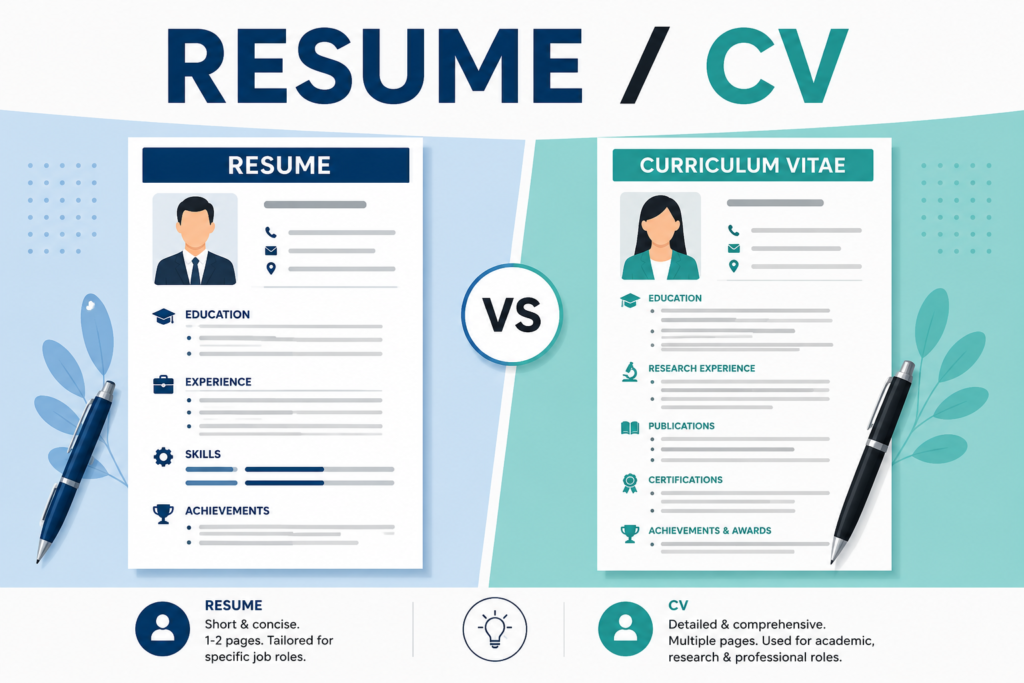
Many people use the terms “Resume” and “CV” interchangeably while applying for jobs. Although both documents are used for professional and job-related purposes, they are not exactly the same. Understanding the difference between a resume and a CV is important because employers and institutions may ask for one specifically during the hiring or admission process.
Resume vs CV – Key Differences
For students, freshers, and professionals, choosing the correct document can improve professionalism and increase opportunities during job applications.
A resume is generally shorter and focuses on skills and experience related to a particular job role. A CV, on the other hand, provides detailed information about academic background, achievements, research work, certifications, and professional experience.
The table below explains the major differences between a resume and a CV in a simple and clear way.
| Feature | Resume | CV (Curriculum Vitae) |
|---|---|---|
| Meaning | A short summary of skills, education, and work experience | A detailed document showing complete academic and professional history |
| Length | Usually 1–2 pages | Can be multiple pages depending on experience |
| Main Purpose | Used for private and corporate job applications | Used for academic, teaching, and research purposes |
| Focus | Job-related skills and achievements | Academic qualifications, research, and detailed career history |
| Customization | Customized for each job application | Mostly fixed with detailed information |
| Content Style | Short and targeted | Comprehensive and detailed |
| Used By | Freshers, professionals, job seekers | Researchers, professors, academic professionals |
| Includes Publications | Usually not included | Often includes research papers and publications |
| Reading Time | Quick review by recruiters | Detailed evaluation by institutions |
| Suitable For | Private jobs, internships, office roles | Higher studies, scholarships, research roles |
| Preferred In | Corporate companies and businesses | Universities and educational institutions |
| Detail Level | Concise information | Extensive professional details |
- What Is a Resume?
- skills
- education
- work experience
- certifications
- achievements
- short
- clear
- easy to read
- focused on relevant information
- What Is a CV?
- educational qualifications
- research work
- teaching experience
- certifications
- publications
- projects
- professional achievements
- academic applications
- research positions
- university admissions
- scholarships
- teaching jobs
- Resume vs CV Length
- one page for freshers
- one or two pages for experienced candidates
- Purpose of Resume and CV
- corporate jobs
- private company hiring
- internships
- entry-level positions
- academic careers
- research programs
- teaching positions
- higher education applications
- Information Included in a Resume
- contact details
- career objective
- educational qualifications
- skills
- work experience
- certifications
- achievements
- Information Included in a CV
- detailed academic history
- internships
- research projects
- teaching experience
- publications
- seminars
- certifications
- awards
- professional memberships
- Which One Should Freshers Use?
- IT jobs
- office jobs
- customer support roles
- entry-level private jobs
- higher studies
- scholarships
- academic programs
- research opportunities
- Importance of Professional Formatting
- be easy to read
- use proper headings
- avoid spelling mistakes
- contain accurate information
- maintain a clean layout
- Common Mistakes People Make
- using unnecessary information
- creating very long resumes
- adding false details
- copying templates without editing
- using poor formatting
- Which Is Better – Resume or CV?
- job type
- industry
- employer requirements
- career goals
- clarity
- honesty
- proper formatting
- relevant information